Reviewed by Dr. Helene A. Miller
Last reviewed: July 2026
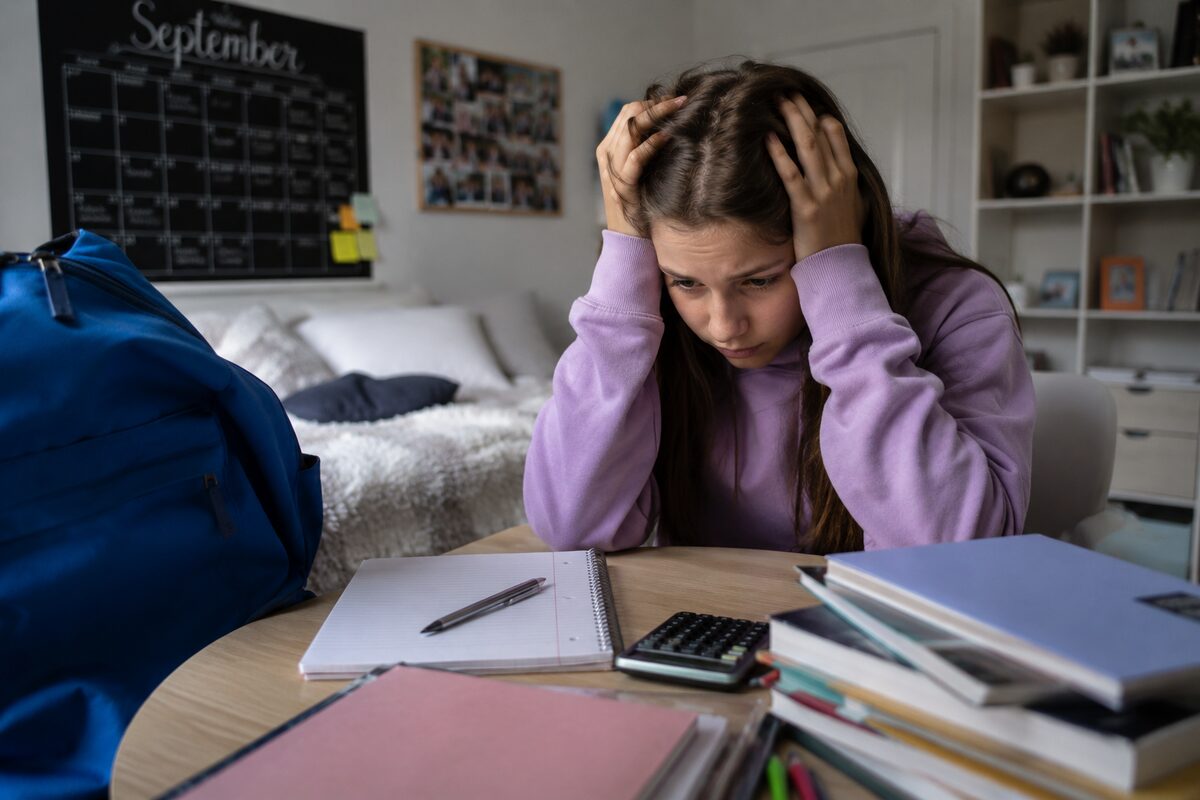
By the second week of August, the stomachaches start. A parent describes a child who is fine all summer and then, around the time the school supply lists go up, develops a stomachache every Sunday night. Or a teenager who has stopped sleeping well, who snaps at everyone, who suddenly will not talk about the school year at all. Or a kindergartner who was excited about “big kid school” in June and is now in tears at the mention of it.
Some version of this happens in a lot of households, and most of the time it is normal. The transition from the loose rhythm of summer to the structure and social pressure of a classroom is genuinely hard, and a child who feels some dread about it is having an ordinary human response. But not always. Sometimes what looks like back to school anxiety is an anxiety disorder that has been there all along and is now getting louder. Knowing the difference lets a parent decide whether to reassure and wait, or to get an evaluation.
Why does back to school anxiety happen?
Back to school anxiety happens because the start of school stacks several stressors at once. A sudden return to structure, performance pressure, social uncertainty, and separation from home all land on a nervous system that spent the summer in a lower gear. For most children this is a short adjustment. For some, it is the point where an underlying vulnerability to anxiety becomes visible.
The specific worry usually depends on the age. Younger children tend to worry about separation: who will pick them up, whether something will go wrong at home while they are gone. Elementary-age children often worry about a new teacher, a harder grade, or not knowing anyone in their class. Teenagers carry a heavier load, including academic performance, where they fit socially, and for many of them a sense that the year ahead is a referendum on their worth. None of that is irrational. School genuinely does ask a lot of children.
What makes the back-to-school window distinct is the speed of the change. Over the summer, the demands ease and the structure loosens, and a child’s system adjusts to that. Then, in the span of a week, the alarm goes off early, the day fills with expectations, and the social world reassembles. A nervous system that has been idling has to rev up fast, and the symptoms of that, including trouble sleeping, irritability, and physical complaints, look a lot like anxiety because, biologically, that is what they are.
How do you tell normal nerves from an anxiety disorder?
You can usually tell by looking at three things: how intense the distress is, how long it lasts, and whether it stops your child from doing things. Ordinary nerves are uncomfortable but they fade as the routine settles, usually within the first two or three weeks. An anxiety disorder is more intense, lasts longer, and gets in the way of normal life.
Here is the practical version. Most children who are just nervous will complain, drag their feet, sleep poorly for a few nights, and then quietly adjust once the first week or two is behind them. The worry shrinks as the unknown becomes known. If that is your child, your job is mostly to stay calm, keep the routine predictable, and resist the urge to over-reassure.
The pattern that should get your attention is different. It is the child whose distress does not ease after a few weeks, or who escalates rather than settles. It is the physical complaints, like stomachaches and headaches, that show up reliably on school mornings and disappear on weekends. It is sleep that breaks down, appetite that changes, or a child who starts avoiding things: refusing to go to school, refusing to ride the bus, refusing activities they used to enjoy. Avoidance is the single most important signal, because avoidance is how anxiety grows. Every time a child escapes the feared thing, the fear gets a little more convincing.
In our practice, the families who turn out to need help are rarely the ones whose child is simply nervous. They are the ones describing a level of distress that is out of proportion to the situation, that is not improving with time, and that is shrinking the child’s world. We often hear a version of “this isn’t just first-week jitters, something is really wrong,” and the parents who say it are usually right.
Not sure if it's more than nerves?
Our intake team can help you decide whether your child would benefit from an evaluation, or whether this is the kind of worry that settles on its own.
What can parents do to ease back to school anxiety?
The most useful thing parents can do is rebuild structure gradually and stay steady, rather than either dismissing the worry or trying to argue the child out of it. Anxiety does not respond well to “there’s nothing to worry about.” It responds to predictability, practice, and a calm adult who treats the feared thing as manageable.
A few specific things help. In the two or three weeks before school, start moving bedtime and wake time earlier in small steps, so the morning alarm is not a shock on day one. Re-introduce some structure to the day, because a loose schedule beats total free time for an anxious child. If it is a new school or building, visit ahead of time if you can. Walking the route, seeing the classroom, and meeting the teacher turns a frightening unknown into a known quantity.
When your child voices a worry, the instinct is to fix it or to minimize it. Try instead to name it and stay calm. “You’re nervous about not knowing anyone in your class. That makes sense. A lot of kids feel that way the first week.” Naming the feeling without catastrophizing it tells the child two things at once: that you take them seriously, and that this is survivable. Then, gently, keep them moving toward the thing rather than away from it. The goal is not to eliminate the anxiety before school starts, but to help the child do the hard thing while anxious, because that is how the anxiety actually shrinks.
What does not help is accommodation that lets the child avoid. Letting an anxious child stay home “just today,” writing the note that gets them out of the presentation, allowing the bus to be skipped in favor of a ride: each feels kind in the moment and makes the next morning harder. This is the hardest part of parenting an anxious child, and the part where outside help is often worth it.
Where do phones and gaming fit in?
Phone or gaming preoccupation is a common companion to back to school anxiety, not the root cause, but often the place the underlying distress is most visible. Many of the teens we work with use the phone or a game as the last thing they let go of before sleep, which makes the underlying pattern easy to miss.
It helps to watch for a shift rather than a quantity. When a game or social media has moved from “they enjoy it” to “it’s where they go when they don’t want to be in their own head,” that is worth paying attention to. The screen is rarely the problem to solve first; it is usually a window into the worry underneath it.
Child and teen evaluations by telehealth
Same-week appointments across New Jersey and New York. The first conversation can happen from home, before the school year gets underway.
When should a child see a professional for school anxiety?
A child should see a professional when the anxiety is intense, lasting more than a few weeks, or interfering with school attendance and daily life, and especially when avoidance has set in. You do not need to wait for a crisis, and you do not need to be certain it is “a real disorder” before reaching out. An evaluation is the place where that question gets answered.
Outright school refusal is the clearest reason to seek help quickly. When a child is missing school, or melting down to the point of not making it out the door, the situation tends to worsen on its own. Each missed day makes the next one harder, and the gaps start to compound. School refusal almost always needs professional support, and the earlier it is addressed, the easier it is to turn around. When anxiety has reached the point of missed days or a needed accommodation, school consultation and clearance support can help coordinate the return, including the documentation schools sometimes ask for, such as clearance for re-entry or input on a 504 plan or IEP.
Short of that, the threshold is simpler than parents think. If the worry is making your child miserable, if it is not getting better with time and your steady support, or if it is shrinking their world, an evaluation is reasonable. A good psychiatric evaluation of a child for anxiety does not pathologize ordinary nerves. It takes a careful history, distinguishes an anxiety disorder from a normal adjustment, and, when treatment is warranted, usually starts with evidence-based therapy designed for childhood anxiety, with medication considered only in specific situations and always in a real conversation with the family. For families who would rather not add a commute and a waiting room to an already-anxious child’s week, telehealth makes the first step considerably lower.
The children we work with at Family Psychiatry & Therapy, and the rest of the young people we see, do best when the worried adults around them get good information early, rather than waiting to see whether a bad pattern resolves on its own. Most childhood anxiety is very treatable. The thing that makes it harder to treat is time spent avoiding. The American Academy of Child and Adolescent Psychiatry offers a helpful overview of anxiety in children, and the National Institute of Mental Health summarizes childhood anxiety disorders for further reading.