Last reviewed: June 2026
The woman in front of me has a six-week-old in a car seat at her feet. She’s exhausted in the way new mothers are exhausted, but it isn’t only that. She tells me she can’t stop checking the baby’s breathing. Forty, fifty times a night. She wakes herself up if she dozes off, panicked that something has happened. She knows objectively that the baby is fine. She still can’t stop.
This is not postpartum depression. This is postpartum anxiety, and we have a recognition problem with it.
For decades, the public conversation about maternal mental health has centered on postpartum depression — and rightly so. But postpartum depression is not the only thing that happens. Research over the past two decades has shown that postpartum anxiety affects somewhere between 15 and 20 percent of new mothers, making it slightly more common than postpartum depression. It can occur alongside depression, or completely independently. And it presents differently enough that the same evaluation that screens for postpartum depression often misses it entirely.
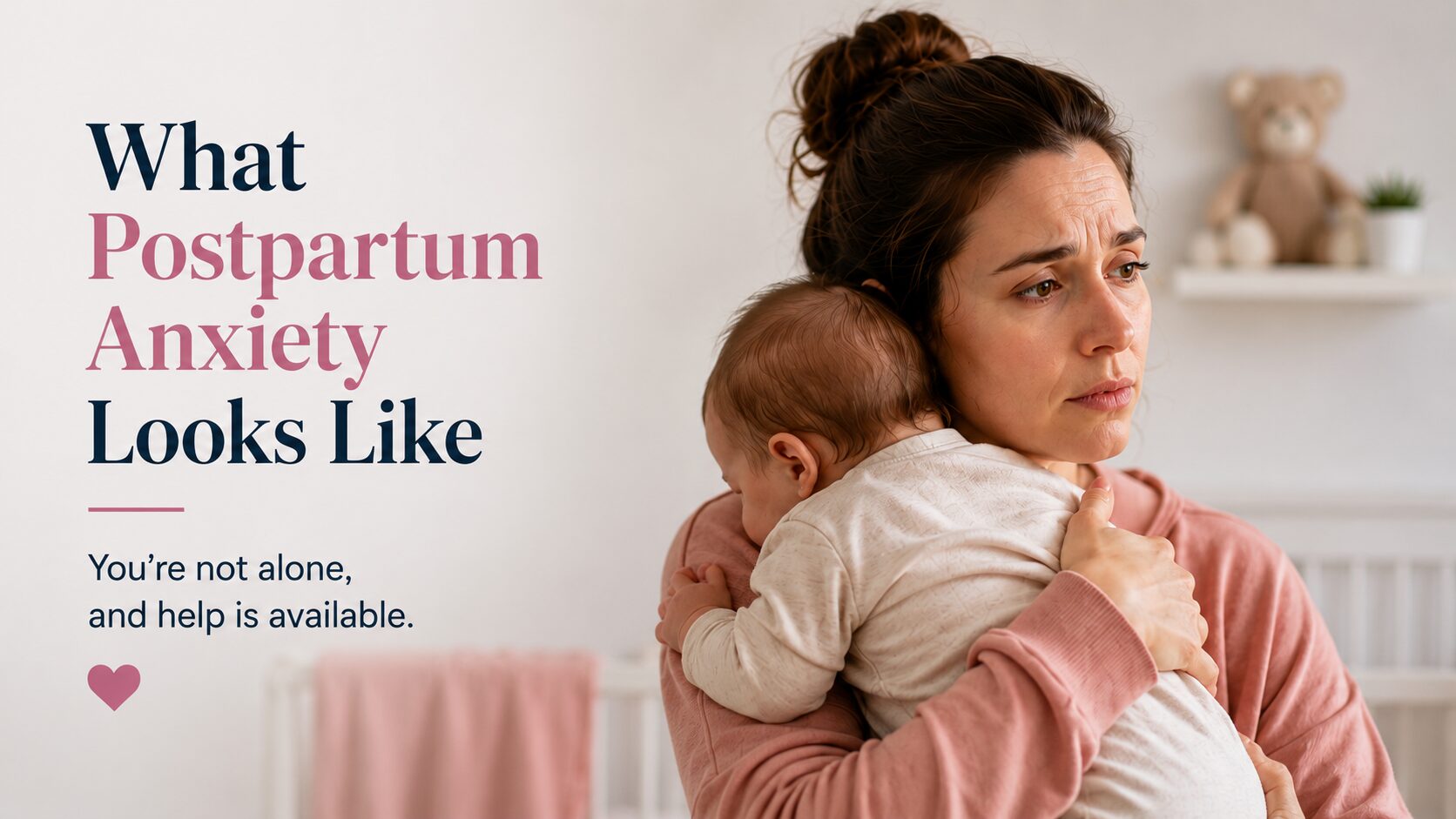
Why does postpartum anxiety get missed?
Postpartum anxiety gets missed because new mothers are culturally expected to worry, and because most women describe their symptoms in ways (“I just need to make sure the baby is safe”) that sound indistinguishable from normal new-parent vigilance.
Two reasons matter more than the others.
The first is cultural. New mothers are expected to worry. The cultural script around new motherhood doesn’t distinguish between adaptive worry — checking that the car seat is buckled, that the baby is breathing during a nap — and clinical anxiety that disrupts function and impairs daily life. A woman saying “I just can’t stop worrying about everything” gets met with “of course, you have a newborn.” The implicit message is that constant worry is the cost of motherhood. For some women, it is, in a limited adaptive way. For others, what’s actually happening is a clinically diagnosable anxiety disorder that won’t resolve on its own.
The second is the way women describe it. Most women with postpartum anxiety don’t say “I have anxiety.” They say “I just want to make sure everything is okay.” They say “I just need to know the baby is safe.” They say “I haven’t slept in weeks but I have a newborn so what do you expect.” The way the symptoms get talked about in primary care and pediatric visits maps directly onto reasonable new-parent vigilance — until you ask the right follow-up questions.
What does postpartum anxiety actually look like?
Postpartum anxiety has a specific clinical fingerprint: hypervigilance that exceeds what the situation calls for, a constantly activated physical stress response (racing heart, chest tightness, shallow breath), and disturbing intrusive thoughts about the baby.
The most distinctive feature is hypervigilance that exceeds what the situation calls for. A new mother checking the baby’s breathing during sleep is normal. A new mother checking forty times a night, every night, for weeks — losing meaningful sleep to it — is not. A new mother who can’t put the baby down without immediate, intense fear that something will go wrong is experiencing something beyond ordinary watchfulness.
The second feature is physical. Racing heart. Shortness of breath. A tightness in the chest that won’t ease. A sense of constant adrenaline. These are the somatic signature of anxiety, and they often get attributed to “just being tired” when the actual mechanism is a chronically activated sympathetic nervous system.
The third feature is intrusive thoughts. This deserves its own section.
What do postpartum intrusive thoughts mean?
Postpartum intrusive thoughts — unwanted, disturbing mental images about the baby — mean in almost all cases that you have a treatable anxiety condition, not that you are a danger to your child. This is the part of postpartum anxiety that frightens women into silence, and it is also the part where the diagnosis matters most.
A significant portion of women with postpartum anxiety — and in milder forms, the majority of new mothers — experience intrusive thoughts. These are unwanted, often disturbing mental images or scenarios involving the baby. Dropping the baby on the stairs. Suddenly leaving the baby in a hot car. In more intense cases, even thoughts of harming the baby directly.
The thoughts are deeply disturbing to the woman having them. They run counter to everything she actually feels about her child. She knows they’re wrong, but she can’t stop them, and she becomes terrified of what they mean.
What they mean, in almost all cases, is that she has postpartum anxiety, often with an obsessive-compulsive dimension. These thoughts are called “ego-dystonic” — meaning the woman experiences them as foreign and horrifying. This is the opposite of what happens in postpartum psychosis, a rare and medically urgent condition where intrusive thoughts can be experienced as beliefs or urges the woman considers acting on. The distinction is critical, and most women experiencing ego-dystonic intrusive thoughts are at very low risk of acting on them.
But women don’t know that. They assume the thoughts mean they’re dangerous to their child, and they don’t tell anyone. They don’t tell their partner. They don’t tell the pediatrician. They don’t tell the obstetrician. And if they do tell someone, they often fear having the baby taken from them.
If you are reading this and recognizing yourself, please tell a clinician. Tell them specifically that the thoughts are unwanted and frighten you. That description — unwanted, frightening, ego-dystonic — is the marker of treatable anxiety, not danger.
Call or text 988 (Suicide & Crisis Lifeline), or call 1-800-944-4773 (Postpartum Support International helpline), or text “HELP” to 800-944-4773. If you are worried you might harm yourself or your baby, please go to your nearest emergency room.
If you're recognizing yourself in this, please reach out.
Our intake team is familiar with postpartum anxiety and the intrusive thoughts that come with it. The conversation is private and there is no judgment.
What does effective postpartum anxiety treatment include?
Effective postpartum anxiety treatment includes recognition of the diagnosis itself, evidence-based therapy (CBT adapted for perinatal anxiety), medication when appropriate (often sertraline for breastfeeding mothers), sleep restoration, and concrete help from a partner. When the underlying condition is identified, treatment is effective and the trajectory is usually short.
The first step is recognition itself. Many women feel meaningful relief just from learning that what they’re experiencing has a name, has been studied, and is treatable. The shame that drives the silence often eases the moment the experience is normalized as a medical condition rather than a personal failure.
Beyond recognition, evidence-based treatment includes cognitive behavioral therapy, particularly approaches developed specifically for perinatal mood and anxiety disorders. Medication can be appropriate depending on severity. Sertraline is often a first-line option for breastfeeding mothers because of decades of data on its safety profile during lactation, but the right choice varies and is worth a real conversation with a psychiatrist who treats this population. The newer neurosteroid options approved for postpartum depression have a more limited evidence base for anxiety specifically, but the field is moving quickly.
Sleep matters enormously, and that’s harder said than done with a newborn. Practical interventions often need to be discussed bluntly. A partner taking a feeding shift. Family rotating overnight help. Accepting that the baby will sometimes cry while the mother sleeps. Sleep deprivation does not just exacerbate postpartum anxiety; for many women it is one of the primary drivers.
The work also doesn’t have to be solo. Partners often want to help and have no idea how. Specific, concrete guidance — share night feedings even if breastfeeding, take the baby for a walk for an hour so she can sleep, don’t ask her if she’s okay, ask her what she needs — turns vague concern into useful support.
You don't have to carry this alone.
Telehealth evaluations are available across New Jersey and New York. The first conversation can happen from home, while the baby sleeps.
When should you seek an evaluation for postpartum anxiety?
Seek an evaluation if you’re a new mother — or any time up to a year or two postpartum — and you recognize yourself in any of this. You don’t need to wait for symptoms to worsen, and you don’t need a referral from your obstetrician first.
You don’t need to wait for someone to ask the right question on a screener. You don’t need to wait for it to get worse. You don’t need it to be confirmed by your obstetrician first. And the existence of intrusive thoughts is not, in itself, evidence that you are dangerous to your child. It is, in almost all cases, evidence that you have a treatable anxiety condition.
What a good evaluation will do is take what you’re experiencing seriously, distinguish among anxiety, depression, and other possibilities, and put you on a treatment plan that recognizes you’re caring for a newborn at the same time. You shouldn’t have to be the only one carrying this.