Last reviewed: June 2026
Many of the adults I see for ADHD come in already knowing what they don’t want.
They’ve read about adult ADHD, often after a sibling, partner, or coworker got diagnosed and recognized themselves. They’ve spent some time on the assessment-and-recognition phase. And by the time they reach my office, they have specific questions about treatment — and a specific concern about stimulants.
Sometimes it’s the daily-controlled-substance piece: not wanting to be on a monthly prescription cycle for the next decade. Sometimes it’s the medication shortages of the past few years and not wanting their function to depend on whether the pharmacy has Vyvanse this month. Sometimes it’s worry about side effects — sleep disruption, appetite suppression, the rebound crash at the end of the day. Sometimes it’s professional concerns — pilots, commercial drivers, certain federal positions, military reservists who would prefer not to disclose a controlled-substance prescription.
For some of these patients, stimulant medication is still the right call clinically, and I tell them so. For many others, a stimulant-free approach delivers comparable benefit with fewer of the practical burdens. That’s the conversation worth having.
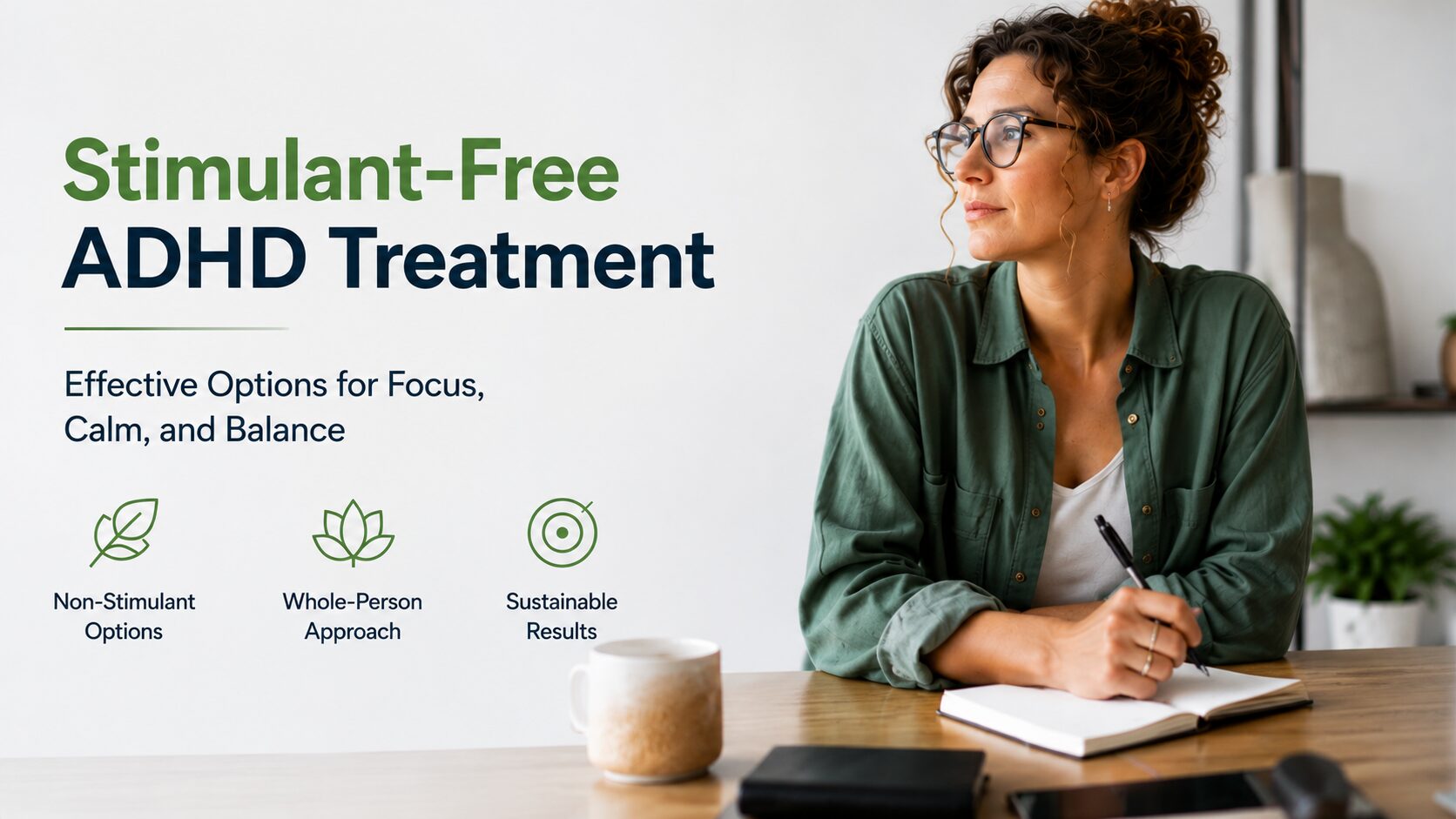
What does stimulant-free adult ADHD treatment include?
Stimulant-free adult ADHD treatment includes FDA-approved non-stimulant medications (atomoxetine, viloxazine, guanfacine ER, clonidine ER, and sometimes bupropion off-label) plus structured behavioral and lifestyle work. It is not the same as no medication at all, and the evidence base for the non-stimulant medication options is substantial.
Atomoxetine (brand name Strattera) is the most established. It’s a selective norepinephrine reuptake inhibitor, taken once daily, not a controlled substance, no abuse potential. The clinical effect builds gradually over four to eight weeks — slower than stimulants, but durable.
Viloxazine (Qelbree) is the newer entry. Similar mechanism to atomoxetine, FDA-approved more recently for both children and adults. Slightly different side-effect profile, generally well-tolerated.
Guanfacine extended-release (Intuniv) and clonidine extended-release (Kapvay) work through a different mechanism — they’re alpha-2 adrenergic agonists. They can be particularly useful when the dominant ADHD symptoms include emotional dysregulation, hyperarousal, or sleep difficulty.
Bupropion (Wellbutrin) is used off-label for ADHD. The evidence is less extensive than for the FDA-approved options, but it’s a reasonable consideration — especially when the patient also has a mood component, low energy, or wants to avoid the sexual side effects associated with SSRIs.
These options are not interchangeable. They have different mechanisms, different time-to-effect curves, and different side-effect profiles. Picking the right one is part of what a real psychiatric evaluation does.
What behavioral and skills work helps adult ADHD?
The behavioral and skills work that helps adult ADHD includes CBT adapted for adult ADHD, executive function coaching, and consistent attention to sleep, exercise, food timing, and alcohol use. Medication is one piece; this is the other piece, and for many patients the more important piece.
Cognitive behavioral therapy adapted for adult ADHD has solid evidence behind it. It’s not generic CBT. It’s a structured approach that addresses the specific patterns of adult ADHD: chronic time-management failure, organizational collapse, the emotional aftermath of years of underperformance, the relationships that have suffered from it. Done well, this is genuinely transformative for many patients.
Executive function coaching is the more practical layer. It’s the externalization of the systems that adults with ADHD often struggle to build internally. Calendars, task-tracking, time-blocking, follow-through routines. Some patients need a coach to help build these from scratch; others need only initial scaffolding.
And the lifestyle foundation matters more than people want to hear. Sleep, exercise, food timing, alcohol — these are not filler advice. They are the foundation that determines whether the rest of the treatment plan works. I’ve stopped being apologetic about saying this in evaluations.
Curious whether stimulant-free ADHD treatment is right for you?
Our intake team can help you figure out whether a non-stimulant evaluation makes sense — or whether a different path fits your situation better.
When are stimulants still the right choice for ADHD?
Stimulants are still the right choice when symptoms are moderate-to-severe and a faster, larger effect is needed than non-stimulants reliably deliver — practice guidelines from major psychiatric organizations position stimulants as first-line for adult ADHD generally. It’s worth being honest about this part.
For some adults with moderate-to-severe ADHD, stimulant medication is the clinically appropriate first-line choice and produces faster, more complete symptom relief than the non-stimulant alternatives. Practice guidelines from major psychiatric organizations still position stimulants as first-line for ADHD generally. The non-stimulant options work, but the effect size for stimulants is larger in head-to-head comparisons.
When patients come to me already on a stimulant that’s working well and they want to stay on it, I’m not going to pressure them off it. That’s not what stimulant-free treatment means. It means we have a specialty in non-stimulant approaches for the patients who can benefit from that path. It does not mean we refuse to discuss stimulants or pretend they don’t work.
For patients who haven’t tried stimulants and aren’t sure, the evaluation includes an honest conversation about both paths and which makes more sense given their specific clinical picture, history, and life situation. The decision belongs to them, with the information they need to make it well.
Why do adults choose non-stimulant ADHD treatment?
Adults choose non-stimulant ADHD treatment mostly for practical reasons: no controlled-substance pharmacy hassles, immunity to stimulant shortages, a milder side-effect profile, no abuse potential, and less stigma at work or with insurance. For the patients who do choose stimulant-free treatment with us, the reasons are practical more often than clinical.
Telehealth and remote monitoring work cleanly without controlled-substance protocols. Most psychiatric follow-up visits can happen by video, on the patient’s schedule. No taking time off work for routine medication checks.
Non-stimulant prescriptions can be refilled normally, sent to any pharmacy, with no monthly paperwork. Treatment doesn’t depend on hand-walking refills through the DEA Schedule II protocols every month.
The medication shortages of the past several years don’t affect this patient population. Treatment continuity isn’t held hostage to whether the local pharmacy has Adderall, Vyvanse, or Ritalin this week.
There’s less stigma. Whether at work, with insurance, or in personal relationships, non-stimulants don’t carry the controlled-substance complications that some patients want to avoid.
The side-effect profile is generally milder. No jitters, no appetite suppression, no rebound symptoms at the end of the day, no sleep disruption, no abuse potential. The effect is slower and quieter, which is what many patients are looking for.
None of these are reasons to choose a less-effective treatment over a more-effective one. They are reasons to choose a treatment plan that fits the specific patient’s clinical picture and life situation — when the clinical picture allows it.
Adult ADHD evaluation by telehealth
Same-week appointments available across New Jersey and New York. No commute, no waiting room, no time off work.
When should you consider an adult ADHD evaluation?
Consider an adult ADHD evaluation if you’re already diagnosed (or you suspect you have ADHD) and you specifically want a treatment plan that doesn’t center on daily stimulant medication. It’s worth being seen by a practice that offers this approach.
What a good evaluation will do is take the full picture seriously. Symptom history. Family history. Co-occurring conditions like anxiety, depression, or sleep disorders. Past treatment experience. Lifestyle factors. Your specific goals and concerns. And then a real conversation about what makes sense given all of it — including, honestly, whether stimulants might still be the right call for you.